 Insights
The Supplier Is Also the Lender: Why Vendor-Financed Compute Needs a Conflict-Aware Asset Graph
Anthropic’s IPO prospectus reveals a financing structure in which Broadcom is not only a critical compute and hardware partner but may also provide up to $42 billion of financing tied to Anthropic’s five-year TPU compute commitments. Reuters reported that the convertible-note capacity could fund about one-third of Anthropic’s $125.2 billion TPU lease commitment, while Broadcom’s own SEC filing says the notes may be issued under certain circumstances and must be used for obligations under the...
This starts a temporary private draft. It is not public, listed for sale or shared automatically.
One counterparty, several contractual roles
A supplier sells something, a lender finances it, a lessor grants the right to use an asset and an equity investor owns part of a company. When different institutions occupy those roles, the boundaries are relatively easy to see. Vendor-financed AI infrastructure brings several of them into the same commercial relationship.
Anthropic’s IPO prospectus, as reported by Reuters on 1 October 2026, describes Broadcom as more than a compute and hardware partner. Reuters reported financing of up to $42 billion linked to Anthropic’s infrastructure commitments, potentially covering about one-third of its $125.2 billion five-year TPU compute commitment. Anthropic itself identifies Broadcom’s overlapping hardware-supply and financing roles as a potential conflict of interest. Reuters: Broadcom to lend Anthropic up to $42 billion to lease its chips, filing says
Convertible-note capacity
Up to $42bn
Conditional maximum aggregate principal described by Broadcom; capacity is not issued or funded debt.
Five-year TPU commitment
$125.2bn
Reuters reported that the financing could cover about one-third of this five-year lease commitment.
Notes issued at 2 August 2026
$0
None had been issued at Broadcom’s quarter end. This dated disclosure does not describe all later financing activity.
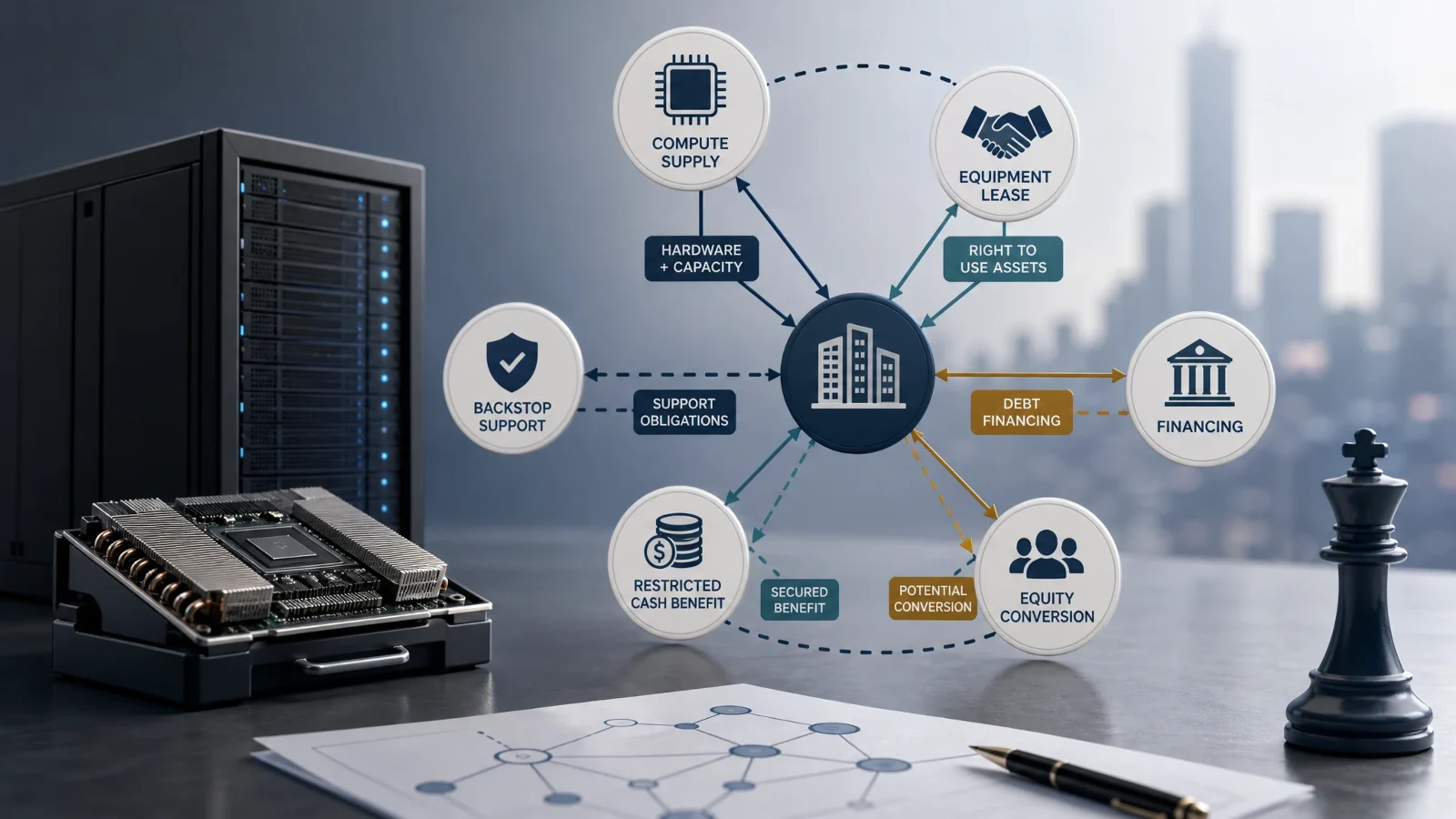
The relationship can include supplier, compute partner, participant in equipment-leasing arrangements, financier, backstop provider, potential equity holder and beneficiary of restricted cash. Each role creates different rights, triggers and exposures. Recording only “Counterparty: Broadcom” leaves the central credit question unanswered: Broadcom as what, under which contract, and on which date?
Anthropic also warned, according to Reuters, that Broadcom’s pricing and hardware-availability decisions could affect its access to sufficient compute infrastructure. The supplier’s commercial choices can therefore affect the customer’s ability to operate the infrastructure supporting its financing obligations. That overlap matters to asset structure as well as governance; a reported potential conflict does not by itself establish misconduct or harm.
Keep compute, leases and financing separate
“AI compute” can describe custom accelerator design, AI racks, physical data-center equipment, a lease right, a compute-capacity right, a service commitment, a financing obligation, restricted cash or convertible debt. Those objects can have separate legal identities. Anthropic’s five-year commitment concerns TPU compute capacity; a hardware inventory alone cannot explain the corresponding entitlement and payment obligations.
The economic chain can run from hardware, through rack or infrastructure deployment and a lease, to a compute-capacity entitlement and a lease-payment obligation. Physical equipment, the right to use it, the service received and the obligation to pay should remain distinguishable.
Broadcom’s Form 10-Q for the quarter ended 2 August 2026 separately says that, in connection with lease agreements enabling access to compute capacity, a customer may under certain circumstances issue Broadcom convertible promissory notes with aggregate principal of up to $42 billion. Any proceeds are restricted to obligations under the relevant lease agreements. The filing says that no notes had been issued as of that date. SEC: Broadcom Form 10-Q for quarter ended 2 August 2026
Records the commitment to pay for contracted compute capacity over its term. Equipment, delivery, capacity rights, payment schedules and lease triggers supply its contractual context.
Records conditional note capacity and any later issuance, funding, outstanding principal, repayment or conversion. Proceeds, if raised, are restricted to obligations under the relevant leases.
A headline capacity of “up to $42bn” must not become “debt outstanding: $42bn”. A financing record may need to distinguish maximum facility or note capacity; amount legally available; amount issued; amount funded; amount outstanding; amount repaid; amount converted; and amount cancelled. At 2 August 2026, maximum potential note principal of $42 billion and actual notes issued of $0 were different states of the same arrangement.
Availability also depends on conditions. Broadcom says notes may be issued under certain circumstances and if needed; Reuters reported that certain payment or performance defaults could constrain access to the facility. Maximum financing capacity therefore cannot substitute for financing legally available after a default. A proposed machine-readable lifecycle would retain capacity agreed, conditions pending, available, note issued, funded, outstanding and repaid, with separate converted or cancelled outcomes and restrictions on further financing after a default.
Conversion creates another branch. Reuters reported that the instruments could convert into Anthropic shares. A conversion trigger or election could reduce or extinguish debt principal and create an equity position. The former creditor may become a shareholder while remaining a supplier, lessor or creditor under other obligations. Repayment, enterprise value, product sales and lease payments create different incentives; the new relationship should be added without overwriting the earlier one.
Restricted cash and default change the liquidity picture
Reuters reported that Anthropic deposited cash into a restricted account for Broadcom’s benefit in April 2026, with further deposits potentially required under certain circumstances. Cash provided by Anthropic but restricted for another party’s benefit is different from unrestricted operating liquidity. A useful record connects total cash, the restricted account, its beneficiary and its release conditions, with provenance for the restriction.
The legal character must come from the governing documents. Restricted cash may be security, a reserve, a deposit, performance support, a payment reserve or another restricted-account structure. Economic similarity alone does not make it a pledge or establish collateral rights. Similarly, cash raised through the proposed notes is not necessarily general corporate liquidity: the 10-Q restricts the permitted use of proceeds to obligations under the relevant leases.
Reuters also reported that certain payment or performance defaults could make a substantial portion of Anthropic’s lease obligations immediately due while constraining access to the $42 billion financing intended to help meet those obligations. A single “Default: Yes” field cannot explain which contract and obligation triggered the event, which other contract is affected, what accelerates or what financing becomes unavailable.
- Operating stress affects payment or performance.
- A default occurs under a particular contract, subject to its terms.
- A substantial portion of lease payments may accelerate.
- Financing access may become constrained at the same time.
- Earlier payment demands increase liquidity pressure.
This is a conditional illustration, not a finding that any default or acceleration has occurred. The governing documents determine the mechanics and any cure, termination or restricted-cash consequences. Acceleration can change timing dramatically without increasing nominal principal, so the original payment schedule, current payment schedule, acceleration state, acceleration date and accelerated amount need separate treatment.
The backstop has a different exposure lifecycle
Broadcom’s 10-Q describes another financial layer separately: a financial partner took on certain AI-rack purchase agreements and related customer leases, and Broadcom provided a backstop to that partner. The backstop grows as racks are delivered and deployed and declines as the customer makes lease payments. Broadcom disclosed maximum potential undiscounted liability of approximately $29 billion after full deployment, and said no amounts had been paid under the Backstop as of 2 August 2026. The filing’s customer description should not be treated as proof that every arrangement concerns the same party or instrument. SEC: Broadcom Form 10-Q
A backstop is a contingent obligation that may never require payment. It is separate from the $42 billion convertible-note capacity. Adding $29 billion and $42 billion mechanically and calling the result a “$71 billion loan exposure” would mix instruments, triggers and states.
Broadcom says that, following customer default, backstop liability is calculated by reference to 85% of the outstanding amount owed under the lease backstop, less the value realised from AI racks. Hardware and recovery value therefore matter to the contingent obligation as well as to compute delivery.
- A backstop agreement becomes active.
- Delivered and deployed AI racks increase the covered exposure.
- Customer lease payments reduce that exposure.
- If default occurs, an asset sale establishes realised rack value.
- The contractual calculation determines any residual liability and potential payment.
Compute capacity and physical rack value answer different questions. Compute may remain strategically valuable while hardware depreciates; racks may retain resale value while a contracted service loses relevance. Neither value should stand in for the other.
Operational milestones can also affect lease commencement, payment obligations, backstop exposure, financing need, revenue recognition and counterparty exposure. A useful chronology distinguishes ordered, manufactured, delivered, installed, commissioned, accepted, compute available and lease payment commenced. Financing consequences may attach to one or more of those events, so delivery and acceptance need their own dates and evidence.
Concentration, assignment and conversion cross contract boundaries
According to Reuters, Anthropic was expected to become Broadcom’s largest compute customer in 2027. Dependency runs in both directions. Anthropic can depend on the relationship for hardware, capacity, pricing, lease structure and financing; Broadcom can face sales, lease-economics, backstop, note and potential equity exposures to the customer. Commercial risk, credit risk, asset risk and equity risk can concentrate in the same relationship without becoming one balance.
A role-specific view should distinguish payables to Broadcom, lease obligations to Broadcom-linked structures, restricted cash for Broadcom’s benefit, convertible-note exposure, hardware-supply dependence, backstop-related exposure and any potential equity relationship. Revenue opportunity and financing exposure should remain visible separately. A customer can be a major source of revenue and a major financing concentration at the same time.
Vendor finance can also move or redistribute part of a customer’s financing problem toward a supplier’s balance sheet or a supplier-supported financing partner. Operating stress can impair lease payments, increase backstop risk, reduce financing availability and intensify liquidity pressure when leases accelerate. Understanding that feedback requires the contractual dependencies and their conditions, rather than a counterparty total alone.
Reuters reported that Broadcom may designate a financing partner. The ultimate lender or note holder may therefore change while Broadcom remains supplier or retains other rights. An event record should retain the original financing provider, designated financing partner, assignment or issuance date, principal amount, current holder and Broadcom’s retained rights. The debt’s identity and history should survive the holder change; the supplier role should not transfer automatically with the financing.
Conversion creates a further relationship fork: debt principal may fall or disappear while an equity holding, voting rights and a different incentive structure emerge. Over time, an unchanged counterparty could be supplier; supplier and backstop provider; supplier and financing provider; supplier and creditor; and potentially supplier and shareholder. Those are possible documented states, not an assertion that every stage has occurred in this case.
A proposed record for a conflict-aware review
The following is a proposed information model for reviewing vendor-financed compute. A complete relationship graph, cross-contract event engine and automated exposure calculations would be further capabilities to develop and validate. This model should not be read as a list of features already supplied by DaDepo.
Parties, commercial commitments and equipment
| Record area | Fields and distinctions to retain |
|---|---|
| Counterparty identity | Legal entity; group; jurisdiction; LEI where available; parent; subsidiaries; effective dates; credit rating; public or private status; source. |
| Relationship roles | Supplier; lessor; service provider; financier; note holder; backstop provider; equity holder; financing partner; beneficiary of restricted cash; guarantor; effective from; effective to; source for each role. |
| Compute commitment | Compute provider; capacity; hardware family; TPU generation; gigawatts; deployment site; contracted start; service term; pricing; minimum commitment; cancelability; acceptance criteria; service-level obligations; current delivery state. |
| Equipment and lease | Lease identifier; lessor; lessee; equipment; rack identifier; delivery tranche; commencement date; payment schedule; residual value; default trigger; acceleration clause; termination rights; current lease state. |
Funding and contingent obligations
| Record area | Fields and distinctions to retain |
|---|---|
| Financing facility and convertible notes | Maximum principal; issuer; lender or note holder; financing partner; availability condition; note issuance date; notes issued; current principal; interest; maturity; permitted use of proceeds; draw restrictions; conversion terms; conversion state; repayment state; current availability. |
| Restricted cash | Account; depositor; beneficiary; amount; currency; deposit date; top-up requirement; release condition; withdrawal restriction; control rights; current balance; current restriction state. |
| Backstop | Backstop provider; financial partner; covered lease; maximum exposure; current exposure; deployment-linked increase; payment-linked decrease; default trigger; asset-sale offset; recovery mechanism; amount paid; current contingent state. |
Events, conflicts and provenance
| Record area | Fields and distinctions to retain |
|---|---|
| Default and acceleration | Triggering contract; default type; payment default; performance default; cure period; cross-contract consequence; accelerated amount; acceleration date; financing availability impact; restricted-cash consequence; termination right; current status. |
| Equity conversion | Convertible instrument; conversion trigger; conversion election; conversion price; shares issued; voting rights; holder; effective date; post-conversion role. |
| Conflict map | Counterparty; role A; role B; potential conflict; affected decision; pricing dependency; supply dependency; financing dependency; governance or approval; mitigation; disclosure source; current state. |
| Provenance | Supply agreement; lease agreement; financing agreement; convertible note; restricted-account agreement; backstop agreement; equipment schedule; acceptance certificate; payment record; SEC filing; IPO prospectus; company announcement; AI-extracted field; professional review; effective date; last-updated timestamp. |
Such a model would make it possible to inspect which party supplies compute, what is leased, which obligations are fixed, what financing is merely available and what has been issued. It would also locate restricted cash and its beneficiary, identify the financial partner bearing risk, explain the backstop and trace any default, acceleration, financing restriction or conversion state to its source.
Financing and contingent-liability states must remain distinct. Notes can move from capacity through availability, issuance, funding, outstanding debt and repayment, or from outstanding debt through conversion to equity. A backstop can instead move from agreement to deployment-linked exposure, payment-linked reductions, default, rack sale, residual shortfall and a potential backstop payment. Neither lifecycle fits in a single “Facility: $42bn” field.
AI can assist extraction while decisions stay with reviewers
AI can help prepare source-linked candidate facts about supplier identities, lease commitments, compute capacity, equipment tranches, financing caps, note issuances, restricted cash, backstop exposure, conversion rights, default triggers, acceleration clauses, financial partners, deployment milestones and payment history. Reconstructing and validating a complete relationship graph from those facts is a broader proposed capability; extraction alone does not establish the graph or its legal meaning.
A future comparison workflow could flag the following issues for professional review:
| Possible recording error | Distinction that needs checking |
|---|---|
| $42bn capacity recorded as debt outstanding; $29bn backstop added to funded debt | Capacity, funded debt and contingent exposure have different meanings. |
| Supplier and lender collapsed into one role; financial-partner debt still shown as Broadcom-held | Role, instrument and current holder need separate identities and effective dates. |
| Restricted cash counted as unrestricted liquidity; lease obligation treated as hardware ownership | Availability of cash, payment obligations and ownership depend on their documents. |
| Convertible debt treated as equity before conversion; lease payments and note repayments double-counted | Conversion state and distinct payment streams must be checked. |
| Default acceleration missing from the liability schedule; financing availability not reduced after a trigger | Contract-specific events may change timing and access to financing. |
| Delivered racks not linked to backstop exposure; hardware residual value missing from a default scenario | Operational milestones and recovery values can affect contingent obligations. |
| Counterparty concentration measured only on revenue; an obsolete contract version driving current exposure | Financing dependency and source-version currency also matter. |
AI should not independently decide that Broadcom acted against Anthropic’s interests, that a conflict caused economic harm, or that vendor financing is abusive or legally problematic. It should not determine whether a financing condition has been met, a default occurred, a lease accelerated, financing became legally unavailable, restricted cash can be released or a backstop is payable. Nor should it determine hardware residual value, decide that a note should convert, or conclude that revenue was improperly recognised. Those judgments require governing documents, applicable accounting rules and qualified professional review.
What DaDepo can contribute today
DaDepo’s useful role is to help prepare reviewable information. A bounded starting point is a private Parties and contractual roles table attached to asset evidence: each row records a party, a named contract, the role described by the source, a document and clause or location reference, a relevant source-stated date and a review status. The same party can appear in different contracts and roles.
Where supported document analysis is enabled, AI can propose source-linked rows for review. Candidates remain suggestions until a user reviews and explicitly confirms them. A role in this table describes a source statement; it does not assign application permissions, establish legal capacity or confirm ownership. Changed source evidence requires renewed review, and access to restricted documents remains controlled by the existing document-access rules.
That table can help answer “What role does this party hold in this contract, and where is the supporting evidence?” It is a practical first step toward more inspectable records. A complete conflict graph, automatic cross-contract triggers, exposure calculations and legal conflict determinations remain further proposed work. The article’s desired information model must not be presented as an existing automated DaDepo function.
Creating or reviewing a vendor-finance record does not mean DaDepo has supplied compute, leased hardware, provided financing, issued convertible debt or determined financing availability. It does not mean DaDepo controls restricted cash, provides a financial guarantee, values AI racks or determines residual value. It also does not establish a payment or performance default, accelerate a lease, convert debt to equity, determine a legal conflict or breach of duty, audit revenue recognition, assess solvency or recommend a financing structure.
DaDepo provides technology and information tools. It does not provide lending, vendor finance, equipment leasing, guarantees, brokerage, legal, accounting, tax, investment or valuation advice or services unless a specific service is expressly identified and lawfully provided. Financing availability, lease rights, restricted cash, backstop obligations, default triggers, acceleration, conversion and conflicts depend on governing documents, authoritative records, applicable law and qualified professional review.
A practical vendor-finance checklist
Before a supplier-financed compute arrangement is treated as one exposure, use these six groups of eight questions. Each question concerns a distinct role, state, condition or source.
Entities and contractual roles
- Counterparty: Which exact legal entities are involved?
- Supplier: Who supplies the hardware or compute?
- Compute provider: Is that the same entity as the supplier?
- Lessor: Who owns or controls the leased equipment?
- Lessee: Which entity owes the lease payments?
- Financier: Who provides financing?
- Financing partner: Can another institution become lender or note holder?
- Backstop provider: Who bears contingent lease-default risk?
Equity, commitments and delivery
- Equity holder: Does any party already hold equity?
- Conversion right: Can debt turn into equity?
- Compute commitment: What capacity is contracted?
- Commitment value: What is the total payment commitment?
- Lease term: How long does the obligation run?
- Cancelability: Which obligations are non-cancellable?
- Delivery: Which equipment has actually been delivered?
- Deployment: Which racks are operational?
Acceptance, lease and financing
- Acceptance: Which tranches have been accepted?
- Lease commencement: When did payment obligations begin?
- Lease obligation: What amount is currently due over time?
- Financing maximum: What is the headline maximum financing capacity?
- Current availability: How much is legally available today?
- Issued notes: How much debt has actually been issued?
- Funded amount: How much cash has actually been advanced?
- Use of proceeds: What may financing proceeds be used for?
Restricted cash, backstop and default
- Restricted cash: What cash is restricted?
- Beneficiary: Who benefits from the restriction?
- Top-up: When must additional restricted cash be posted?
- Release: When can restricted cash be released?
- Backstop maximum: What is the maximum contingent exposure?
- Current backstop: How much exposure currently exists?
- Asset offset: How does equipment resale value reduce backstop exposure?
- Default: Which payment or performance events constitute default?
Cure, conversion and supply
- Cure: Is there a cure period?
- Acceleration: Which lease obligations can become immediately due?
- Financing restriction: Does default reduce access to financing?
- Termination: Which contracts can terminate after default?
- Conversion: What triggers debt-to-equity conversion?
- Post-conversion rights: What rights does the new shareholder obtain?
- Supplier pricing: Can the supplier alter pricing materially?
- Hardware allocation: Can supply decisions affect compute access?
Conflicts, concentration and evidence
- Conflict map: Which roles are held by the same counterparty?
- Mitigation: What governance or contractual controls address those overlaps?
- Concentration: How dependent is the customer on the supplier?
- Reverse concentration: How exposed is the supplier to the customer?
- Current exposure: Can funded, contingent and operational exposures be separated?
- Hardware value: What is the current residual value of deployed equipment?
- Payment history: Are lease payments current?
- Provenance: Can every role, amount and trigger be traced to a source and date?
If the answer to “Which role does this counterparty play in each contract, what does it own or finance today, and how does one contract change the state of another?” is unclear, the vendor-finance record is incomplete.
A relationship model that extends beyond AI compute
The same need to distinguish commercial and financial roles appears across private markets.
| Market | An overlapping relationship to examine |
|---|---|
| Aircraft finance | A manufacturer may sell aircraft while providing customer financing or guarantees. |
| Equipment leasing | A vendor may arrange leases, residual-value support and financing through affiliates or partners. |
| Auto finance | Manufacturers can combine product sales with captive financing. |
| Renewable energy | Equipment suppliers may support project financing or performance guarantees. |
| Telecom infrastructure | Vendors can finance equipment that generates the revenues used for repayment. |
| Data centers | Hardware suppliers, tenants, lenders and project vehicles can overlap economically. |
| Trade finance | A supplier may extend payment terms and fund the buyer through another instrument. |
| Private credit | Sponsors or strategic partners may supply commercial contracts and rescue financing. |
Broadcom’s connection to the compute supply chain, equipment leasing, a financial partner’s backstop, possible convertible debt, restricted cash and potential equity conversion illustrates the structural question. Anthropic depends on compute capacity, while financing may help fund obligations created by that same broader relationship. Those statements can all be true without describing one contract, one balance or one current legal role.
A proposed conflict-aware graph would connect supplier to capacity; the relevant lessor or partner structure to the lease obligation; a financier to convertible-note capacity; Anthropic’s restricted cash to its beneficiary; Broadcom’s backstop to the financial partner; and any converted debt to the resulting equity relationship. Each connection needs its own amount where applicable, trigger, lifecycle and provenance. Some contractual events can change the state of another connection.
A counterparty name is not a relationship. When the same institution supplies an asset, finances its use and may become an equity holder, every contractual role needs its own identity and lifecycle.
Further reading
- Reuters: Broadcom to lend Anthropic up to $42 billion to lease its chips, filing says
- SEC: Broadcom Form 10-Q for quarter ended 2 August 2026
- Broadcom: April 2026 Form 8-K on expanded Google and Anthropic compute collaboration
- Anthropic: Expanded partnership with Google and Broadcom for next-generation compute
- Reuters: Anthropic’s $518 billion AI buildout hinges largely on deals that cannot be canceled