 Insights
All insights
Search and filter every published DaDepo guide for preparing document-backed assets.
Browse by topic
All Topics represented in published guidance.
Browse guides
Search and filter published English guidance by audience, asset type, journey stage, or Topic.
Guidance desk
1–12 of 69 published guides-
01
 Guide
GuideReceivership Is Not One Transfer: Why Failed-Bank Loan Portfolios Need Asset-Level Ownership State
Nano Banc's resolution separated an institution-level event from the disposition of individual assets. The announcements describe assets acquired and assets retained, but they do not identify the owner of each loan. Reliable transition records must distinguish loan ownership, servicing, payment instructions and later sales, with evidence and effective dates for each.
Read article- Audience
- Servicer
- Asset
- Debt portfolio
- Stage
- Learn
- Topics
- ownership and title debt portfolios loan state history
-
02
 Guide
GuideThe Loan Is Not the Only Leverage: Why Private Credit Needs a Fund-Level Debt Map
A private-credit fund can own loans and borrow against its portfolio, while a feeder adds another financing layer. Each claim has different debtors, collateral and calculation rules. A useful debt map keeps those layers separate, connects their evidence and shows how a change in portfolio value can affect fund financing and investor cash flows.
Read article- Audience
- Asset manager
- Asset
- Debt portfolio
- Stage
- Learn
- Topics
- debt portfolios institutional capital credit data and risk
-
03
 Guide
GuideThe Loan Is Repaid. Is the Bitcoin Free? The Evidence Behind Collateral Release
Riot Platforms' September 2026 payoff shows why debt repayment, custody and release from a lender's security interest need separate records. Its changing bitcoin collateral balances also show why a dated quantity cannot be treated as the amount released months later. A useful review connects each event to its source, scope and effective date.
Read article- Audience
- Lender
- Asset
- Secured loan
- Stage
- Learn
- Topics
- collateral secured lending custody
-
04
 Guide
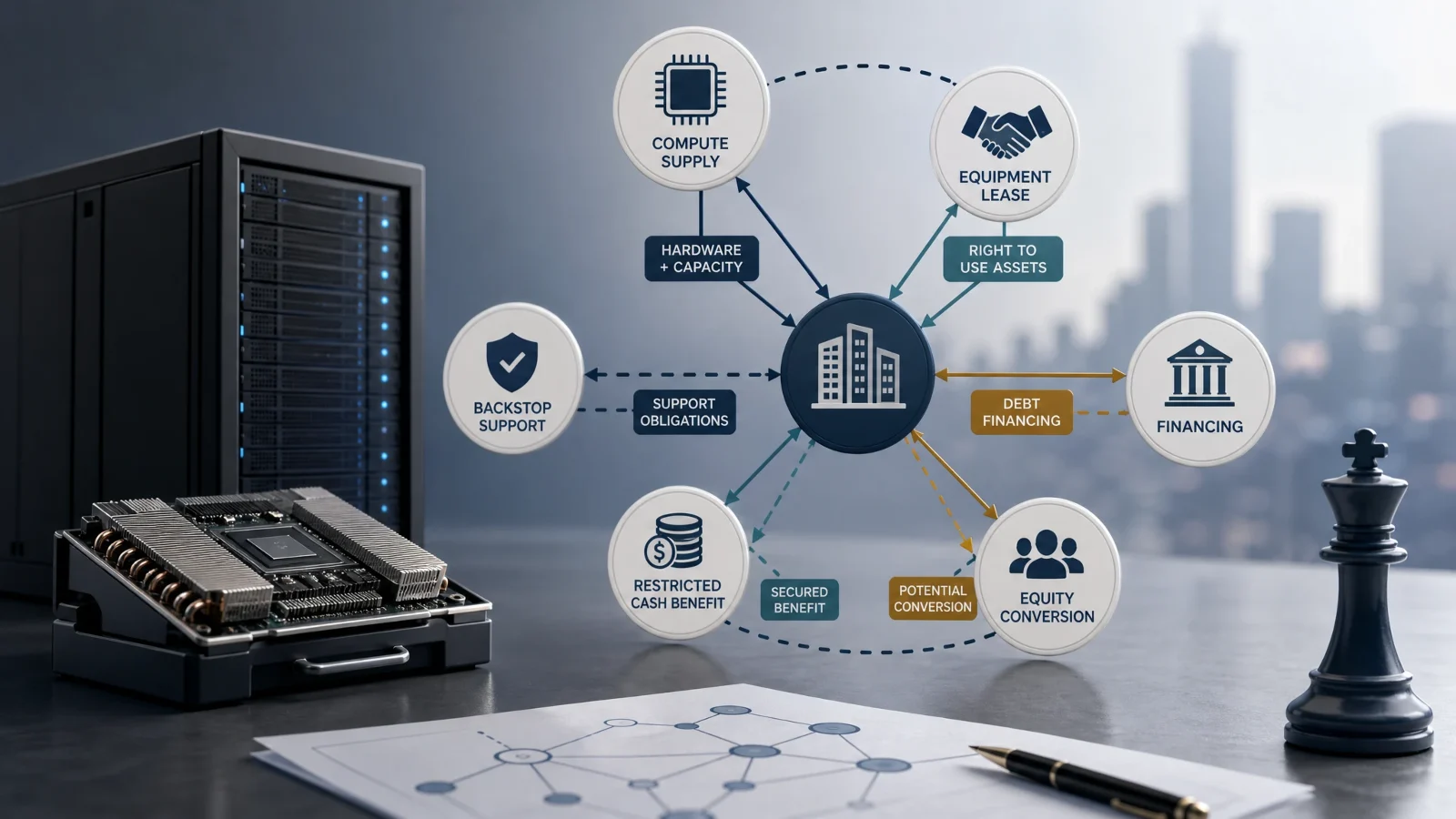
GuideThe Supplier Is Also the Lender: Why Vendor-Financed Compute Needs a Conflict-Aware Asset Graph
Anthropic’s IPO prospectus reveals a financing structure in which Broadcom is not only a critical compute and hardware partner but may also provide up to $42 billion of financing tied to Anthropic’s five-year TPU compute commitments. Reuters reported that the convertible-note capacity could fund about one-third of Anthropic’s $125.2 billion TPU lease commitment, while Broadcom’s own SEC filing says the notes may be issued under certain circumstances and must be used for obligations under the...
Read article- Audience
- Credit manager
- Stage
- Learn
- Topics
- vendor finance compute equipment leasing
-
05
 Guide
GuideThe Payment Is Overdue. The NPL Flag Says No: What Vanke Reveals About Credit Classification State
Reuters reported in September 2026 that Chinese financial regulators had informally asked some major banks not to classify overdue loans to China Vanke as non-performing, while also encouraging maturity extensions and, in some cases, deferred interest collection. The reported guidance is not a published regulatory rule, but it exposes an important private-credit data problem: contractual payment state, days past due, forbearance, restructuring, regulatory classification, accounting...
Read article- Audience
- Credit manager
- Asset
- NPL
- Stage
- Learn
-
06
 Guide
GuideThe Project Was Funded. The Debt Did Not Move: What $18 Billion of AI Loans Reveals About Distribution Risk
Project Jupiter, a New Mexico data-center development linked to Oracle and OpenAI, raised about $18 billion of project-finance loans from a large bank group in late 2025. The financing was designed to be distributed more broadly to banks and institutional investors. By September 2026, however, Financial Times reporting cited by Reuters said syndicate banks were quoting the loans at 89–91 cents on the dollar and that attempts to sell the debt more widely had stalled, leaving banks with more...
Read article- Audience
- Credit manager
- Asset
- Secured loan
- Stage
- Learn
-
07
 Guide
GuideA 5% Exit Door for an 11.4% Queue: What Semi-Liquid Private Credit Reveals About Asset Liquidity.
Investors in Morgan Stanley’s North Haven Private Income Fund tendered 11.4% of outstanding units for repurchase in its third-quarter 2026 liquidity window, while the fund’s offer covered only about 5%. The mismatch follows similarly oversubscribed repurchase offers in the first and second quarters. Yet the deeper lesson is not simply that investors wanted liquidity. A private-credit fund interest has a different liquidity lifecycle from the loans held inside the fund. Portfolio assets can...
Read article- Audience
- Asset manager
- Asset
- General
- Stage
- Learn
-
08
 Guide
GuideInstitutional Capital Does Not Buy Projects: Why Private Assets Need to Become Portable Before They Become Investable
The World Bank Group says it mobilised a record $112 billion of private capital in FY2026 and wants to exceed $200 billion within two to three years. The strategic shift is not simply to originate more projects. It is to standardise and package loans into structures that pension funds, insurers and asset managers can hold. IFC’s Emerging Markets Securitization Program shows the model in practice: two CLO transactions have issued more than $1 billion of securities backed by 119 IFC-originated...
Read article- Audience
- Asset manager
- Asset
- Debt portfolio
- Stage
- Learn
- Topics
- originate to distribute asset standardisation emerging markets
-
09
 Guide
GuideFunding the Claim Is Not Owning the Claim: What Mariana Reveals About Litigation-Finance Rights
The Mariana dam litigation has exposed a private-asset problem that is usually hidden inside funding agreements: a claimant can own the cause of action, lawyers can control day-to-day litigation, a client committee may hold strategic authority, a litigation funder can finance the case and receive a share of proceeds, and none of those roles is automatically the same as owning or controlling the claim. Financial Times reporting in September 2026 described a dispute involving funder Gramercy,...
Read article- Audience
- Lawyer
- Asset
- Claim
- Stage
- Learn
- Topics
- litigation finance claim control funding rights
-
10
 Guide
GuideThe Gold Stays in the Vault. The Rights Move: Why Tokenised Commodities Need an Asset Passport
The UK Financial Conduct Authority is exploring whether tokenised gold can improve how bullion is traded, transferred, pledged and held, with wholesale collateral identified as a particularly important use case. The consultation exposes a deeper infrastructure problem: the token is not the gold. A serious institutional record must connect the physical bullion, vault and custodian, legal ownership, digital representation, redemption rights, encumbrances, transfers and collateral state....
Read article- Audience
- Asset manager
- Asset
- General
- Stage
- Learn
- Topics
- tokenised commodities gold collateral
-
11
 Guide
GuideA $1 Billion Claim Is Not a $1 Billion Asset: What 1MDB Shows About Recovery Rights
Liquidators of four companies have sued DBS Bank in Singapore for an estimated S$1.298 billion in damages in connection with 1MDB recovery efforts. DBS categorically rejects the claim and has made no provision for it. The case is a useful illustration of a broader private-asset problem: once the original money has moved or disappeared, the economically relevant asset can become a recovery right. But the amount claimed, the expected value of the claim, a judgment, cash actually recovered and...
Read article- Audience
- Lawyer
- Asset
- Claim
- Stage
- Learn
- Topics
- asset recovery litigation claims insolvency
-
12
 Guide
GuideAn Insured Invoice Is Still Not a Verified Receivable: What Radiant World Reveals About Trade-Credit Evidence
The Radiant World disputes have moved beyond lenders and commodity counterparties into trade-credit insurance. The Financial Times reported that Zurich and Allianz Trade wrote policies covering transactions linked to the embattled iron-ore trader, including Zurich cover tied to non-payment by counterparties such as Glencore. That adds a new layer to a case already involving allegations that some invoices used in financing were invalid or had already been paid. The lesson is not that...
Read article- Audience
- Credit manager
- Asset
- Invoice
- Stage
- Learn
- Topics
- receivables verification invoice finance trade credit insurance