 Insights
The Bond Was Already Digital: What India’s First Tokenised Bond Actually Changes
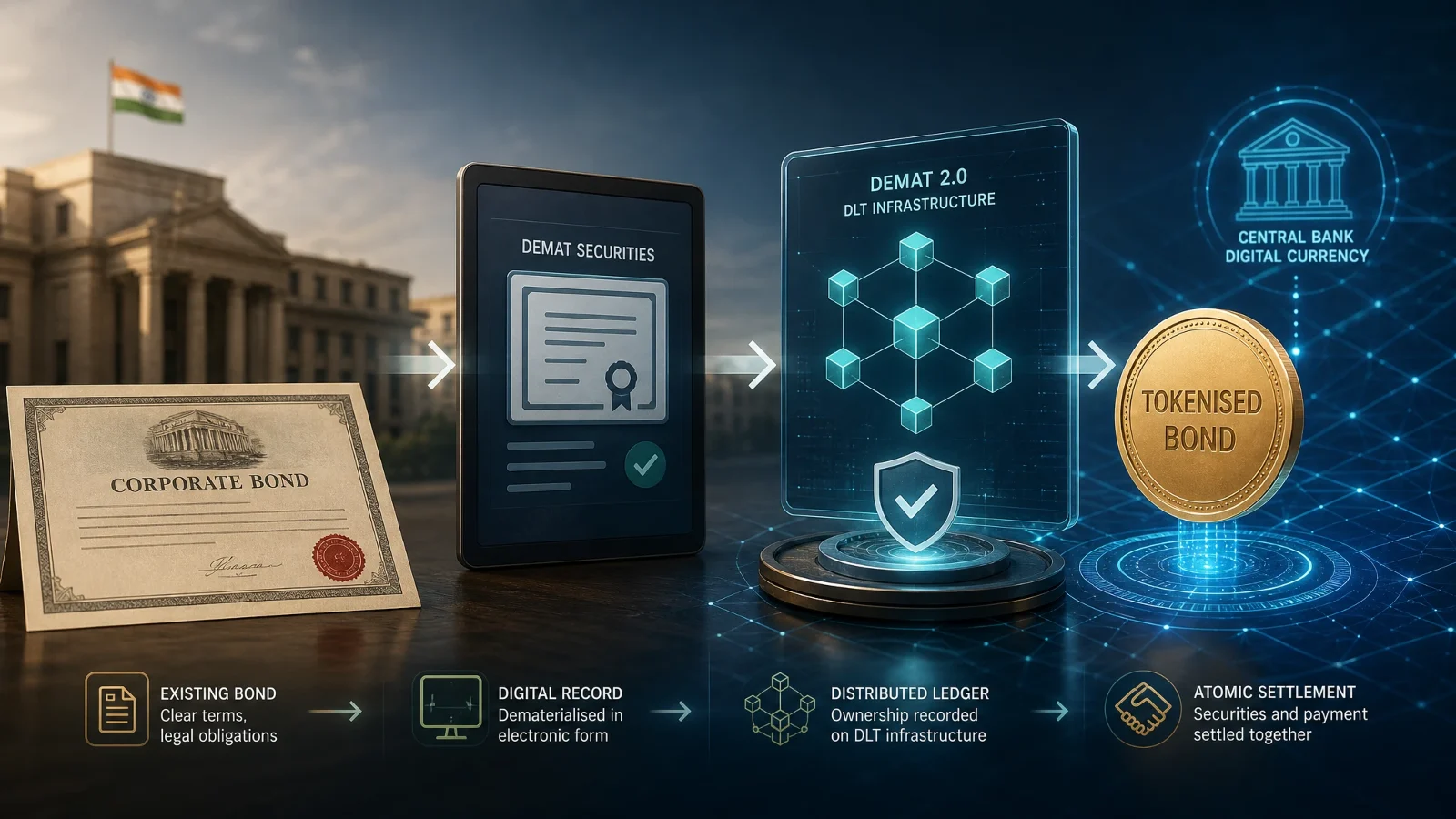
REC’s ₹500 crore issuance under India’s regulatory sandbox is the country’s first tokenised corporate bond, but the underlying bond market was already dematerialised. The important change is therefore not that a paper bond became digital. Demat 2.0 moves the securities record onto distributed-ledger infrastructure while the RBI’s wholesale CBDC provides a digital cash leg, allowing atomic delivery-versus-payment and same-day pay-in, allotment and listing. The experiment exposes a broader...
This starts a temporary private draft. It is not public, listed for sale or shared automatically.
REC Limited's tokenised-bond pilot raises a more useful question than whether a security can exist without paper: what changes when the bond was already digital? Indian corporate bonds already had issuers, electronic holdings, legal terms, identifiers and depository records. The new experiment concerned how those holdings and the cash leg could move together.
On 7 September 2026, the state-owned infrastructure financier raised ₹500 crore through India's first pilot tokenised corporate-bond issuance under SEBI's Regulatory Sandbox Framework. Reporting described a ₹100 crore base issue, a ₹400 crore greenshoe, ₹796 crore of bids, a 7.30% annual coupon and a one-year, nine-month tenor. Bidding used NSE's electronic bond platform. The securities were represented through Demat 2.0, developed by Indian depositories, and payment used RBI's wholesale CBDC. Public reporting said atomic delivery-versus-payment enabled same-day pay-in, allotment and listing. Financial Express: REC issuance, Business Standard: What changes, Financial Express: Debt-market implications
The instrument persists while its representation changes
Paper certificates, dematerialised book entries and DLT representations are different ways of recording or moving a security. Dematerialisation already removed paper. Adding DLT does not automatically create a new bond or replace the issuer's obligations.
REC still owes principal and coupon under the issue terms. Credit, interest-rate and liquidity risk remain, as do documentation, investor rights, record dates and corporate actions. The issuer can default, yields can change and secondary liquidity can be weak. A token cannot resolve those matters merely by representing the position.
An authoritative instrument identifier should connect the legal issue, depository record and DLT representation. A conventional “REC 7.30% Bond A” and a digital “REC Token 7.30% Bond X” need a durable mapping if they describe the same security. Reviewers should be able to identify the governing documents, ledger, relationship to depository records, authorised creation and extinguishment process, conflict rules and authority for each fact.
One instrument might eventually have conventional demat, DLT, custody or collateral representations, or use another regulated settlement rail where the framework permits. That does not necessarily mean several bonds exist. For each representation, preserve its type, network, wallet or account, quantity, creation event, mapping rule, current status, authoritative source, reconciliation time and extinguishment event.
Wallet access and legal ownership require a defined relationship
A securities wallet is an account or control interface; it is not the bond. Identity should survive wallet replacement, changed custody or technical provider, renewed credentials, transfer to another eligible participant and ledger migration.
The ability to sign a transaction does not, by itself, establish legal ownership. Institutional records also distinguish account holder, beneficial owner, custodian, pledgee, trustee and nominee. Restrictions, court orders, insolvency, sanctions, settlement finality and the legal effect of the book entry can affect what the position means.
Reuters' pre-issuance reporting identified NSDL and CDSL as participants in developing Demat 2.0. The completed pilot therefore brought a live bond into a design involving existing regulated institutions. Reuters: Pre-launch plans
The depositories' continuing role matters. Issuance, account opening and identity, participant eligibility, creation, transfer, cancellation and correction, settlement, corporate actions, failure recovery, disputes, retention, regulatory access and finality still need rules. Distributed technology changes the machinery; it does not make the record ungoverned.
Custody likewise needs more than a key: custodians, depositories and account providers, key management, segregation, recovery, authorised signatories, operational and sanctions controls and succession arrangements all remain relevant.
Atomic DvP links two assets without merging them
The bond and wholesale CBDC are separate assets. Before settlement the investor has cash and the issuer or seller has the security; afterward the positions reverse. Atomic DvP attempts to make the transfers indivisible: security moves if and only if cash moves.
Identify the instrument, quantity, seller, buyer, account and delivery status. The DLT position must remain mapped to the underlying bond.
Identify the amount, currency, payer, payee, CBDC wallet and payment status. Connect both legs through the allotment or trade reference, DvP condition, timestamp and finality state.
A transaction hash can evidence the connection, but cannot replace those definitions. Tokenised securities could also settle against traditional bank money; using digital central-bank money here allowed closer coordination of the payment and security workflows.
Same-day pay-in, allotment and listing compressed hand-offs between bidding, allocation, payment, securities creation, account credit, reconciliation and listing. It shortened the issuance lifecycle rather than simply accelerating a token transfer. As the time available after execution decreases, incorrect accounts, insufficient cash, eligibility problems, allocation errors, instrument mismatches, failed instructions and reconciliation breaks have to be resolved earlier.
Speed does not determine finality or record authority
A ledger can mark a transfer complete in seconds while legal finality remains a separate determination. The governing framework must establish irrevocability, the entry with legal effect, permissible reversals and error correction, insolvency treatment of unsettled instructions, court freezes, failure procedures and priority between conflicting records. Neither DaDepo nor an AI reviewer should infer finality from speed.
An electronic market already has issuer, depository, exchange, custodian and broker records, investor statements and internal accounts. A DLT record is useful when its authority is defined for the right purpose.
| Fact | Relevant authoritative source or process |
|---|---|
| Legal bond terms | Issue documents. |
| Instrument identity | Security master and depository framework. |
| Current DLT position | Demat 2.0 ledger under its governing framework. |
| Cash movement | Wholesale-CBDC infrastructure. |
| Listing | Exchange records. |
| Corporate action | Issuer, registrar and depository processes. |
The objective need not be one database controlling all facts. Different authoritative systems can refer to the same instrument. A proposed evidence record should connect those sources while preserving their distinct authority.
Coupon, redemption and correction test continuing consistency
Corporate actions require interest calculations, record dates and entitlement, payment, maturity processing, notices, defaults, restructuring, relevant call or put rights and amendments. If a coupon-date ledger shows Investor A with 100 units while another authoritative record shows 80, the entitlement process needs reconciliation before payment.
Maturity also has two connected events: the bond's legal redemption and extinguishment of its digital representation. Burning a token does not prove that principal was repaid or the obligation legally ended. Conversely, a redeemed bond can remain wrongly active on a technical system. Issued, outstanding, transferred, coupon events, maturing, redeemed and closed should remain distinguishable.
Corrections need an auditable process. Wrong allocations or accounts, failed transactions, court orders and corrected corporate actions cannot be handled by claiming errors are impossible to change. A useful history retains the original instruction, detected error, correction authority, reversal or replacement and current valid state. It prevents secret overwriting while permitting authorised repair.
The same provenance is needed for a statement such as “I own ₹10 crore of REC bonds.” The statement should trace through investor identity, account or wallet, current position, instrument, acquisition or allotment and settlement. A ledger can reliably preserve creation, transfer, timestamps, wallets, quantities and references while still preserving an incorrect instrument mapping, wallet or quantity. History alone does not establish correctness.
Secondary trading adds eligibility and liquidity constraints
Primary issuance connected issue, cash, allotment and listing. Secondary trading has to test eligible buyers, actual seller holdings, pricing and matching, compatible wallets, available cash, DvP, finality, record dates, restrictions and interoperability.
Pre-launch Reuters reporting described an initial three-month lock-in; Financial Express reported secondary trading as pending during that initial period. The article's account of the completed issuance should not be read as proof that all later-market functions had already launched.
The ₹796 crore of bids demonstrates interest in that issuance, not guaranteed liquidity for every tokenised bond. Issuer credit, demand and pricing, investor participation, market-making, restrictions, wallet access, settlement infrastructure, issue size, regulation and conventions still matter. A willing buyer may lack compatible wholesale-CBDC and Demat 2.0 access, or legal eligibility to receive the instrument. Efficient transfer infrastructure does not manufacture buyers.
A proposed evidence model around the digital security
A “Tokenised: Yes” checkbox cannot identify what is represented, where, by whom, under which authority, whether holdings reconcile, how transfer and cash settlement work, how finality is established, or how corporate actions and extinguishment occur. A proposed layered record would make those matters inspectable.
| Layer | Information to preserve |
|---|---|
| Legal instrument | Issuer, type, issue date, face value and total size, currency, coupon and maturity, seniority and secured/unsecured status, documents, law, official identifier, listing and current legal status. |
| Instrument identity | Issuer identifier, issue/series, security-master and depository sources, version and amendments, superseded identifiers, corporate-action history and reconciliation. |
| Depository representation | Depository/account structure, issued and outstanding quantities, holder and position, record date, transfer status, freezes, restrictions, pledges, source timestamp and record authority. |
| Digital representation | Infrastructure/network, Demat 2.0 or equivalent, ledger identifier and representation type, creation authority/event, quantity and mapping, wallet, current state, cancellation/burn process and reconciliation. |
| Investor position | Investor, participant and beneficial owner where relevant, account/wallet, quantity and acquisition date, restrictions, pledges, freezes, current position and as-of time. |
| Cash | Settlement asset and currency, CBDC or other cash form, payer/payee and wallets, amount, instruction, status/time, failure and reversal or correction. |
| Settlement | Transaction and both instructions, DvP rule, venue, matching and pending states, atomic execution/time, finality source, failure, correction/reversal and reconciliation. |
| Corporate actions | Coupon, record date, entitlement and payment date, notice, redemption/maturity, amendment, default, restructuring and evidence of completion. |
| Eligibility | Investor class, regulatory and wallet eligibility, CBDC/depository access, compatibility, restrictions and lock-in, effective date and reviewer. |
| Provenance | Issue and issuer records, exchange/depository/DLT/wallet/CBDC evidence, corporate-action notices, regulator, extracted and user-confirmed fields, professional review, effective date, version and last update. |
This is a proposed information model for review. DaDepo's existing bounded contribution is private document-backed preparation and reviewable asset information. It does not imply a live connection to Demat 2.0, automatic cross-ledger reconciliation or operation of the settlement rail.
Suggested document findings can help a reviewer identify issuers, terms, identifiers, quantities, wallet and allotment references, depository positions, payment and transaction references, timestamps, corporate-action dates, listing and amendments. Future specialised reconciliation could flag mismatched issued and digital quantities, inconsistent depository/wallet positions, duplicate representations, wrong identifiers, stale record-date holdings, redeemed bonds still active, cash failure with apparent delivery, identity conflicts, lock-in transfers or wallets no longer associated with an authorised investor. Those are proposed checking functions, rather than claims that every test exists in DaDepo.
AI cannot establish title transfer, ledger authority or legal finality; validate issuance or securities status; decide eligibility, disregard a depository record, authorise reversal, equate wallet controller and beneficial owner, complete a legal corporate action or determine investment suitability. An Asset Passport does not issue or validate securities/tokens, assign official identifiers, maintain the authoritative register, provide custody or wallets, move central-bank money, match, clear or settle trades, approve investors, transfer title, process corporate actions, value securities or guarantee coupon or principal. Legal, regulatory, depository, custody, brokerage, investment, tax, accounting, valuation, issuance, CBDC and payment services require their own express and lawful basis.
Questions for a digital-security review
The instrument and its representations
- Instrument: What exact security does the digital representation refer to?
- Issuer: Which legal entity owes the security obligations?
- Terms: Which issue documents define principal, coupon, maturity and investor rights?
- Identifier: Which official or market identifier anchors the instrument?
- Representation: What does the token or DLT entry represent?
- Mapping: How is the digital identifier linked to the underlying instrument identifier?
- Issued quantity: How many units legally exist?
- Digital quantity: How many units are represented on the DLT layer?
- Reconciliation: Do those quantities match?
- Depository: Which regulated depository or record-keeping infrastructure is involved?
- Authoritative record: Which record is authoritative for current holdings or legal ownership?
The holder and settlement
- Investor: Which legal entity holds the position?
- Wallet: Which wallet or account represents that participant?
- Control: Who is authorised to operate the wallet?
- Eligibility: May that participant legally and technically receive the security?
- Restriction: Does a lock-in or other transfer restriction apply?
- Cash asset: Which payment asset settles the transaction?
- Cash wallet: Which account or wallet provides the cash leg?
- DvP: How are securities and cash transfers linked?
- Settlement: What event indicates that the transaction completed?
- Finality: Which rule or authoritative system determines legal settlement finality?
- Failure: What happens if one leg cannot complete?
The continuing lifecycle
- Correction: How is an erroneous transaction corrected without hiding the history?
- Coupon: How are entitlement and payment determined?
- Record date: Which holding record controls a corporate-action entitlement?
- Maturity: How is the security redeemed?
- Extinguishment: How is the digital representation cancelled when the legal security ceases to exist?
- Secondary trading: Which participants and venues can transfer the security after any lock-in expires?
- Interoperability: Can the position move between conventional and DLT infrastructure if the framework permits it?
- Custody: What happens if access credentials are lost or compromised?
- Provenance: Can every material state be traced to the issuer, depository, DLT ledger, exchange, wallet and settlement evidence?
- Consistency: Can an authorised reviewer confirm that every system is still talking about the same bond?
These distinctions extend to receivables with contracts, Passports, representations and financing positions; loans with agreements, servicing, participations and tokenised interests; and claims with causes of action, funding rights and economic participations. A representation must stay attached to the legal and economic right.
For REC's pilot, the meaningful transition was from an existing dematerialised security to DLT-based holdings coordinated with digital central-bank-money settlement. Repeat issuance, secondary trading, corporate actions, interoperability, institutional custody, reliable settlement, oversight, correction, servicing and maturity are the continuing tests. A faster rail increases the value of a durable record identifying the exact security, investor, wallet, quantity, cash, restrictions and authoritative source before execution.
Further reading
- Financial Express: REC raises Rs 500 crore via tokenised bonds
- Financial Express: What tokenised bonds mean for India's debt market
- Business Standard: India's first tokenised bond—what changes when debt moves to blockchain
- Reuters: India plans first tokenised bond issue in September
- WebIndia123 / REC release: India's first Pilot Issue under SEBI Regulatory Sandbox Framework
- CDSL: Corporate Bond Database